 U.S.S.R.PremiumLesta
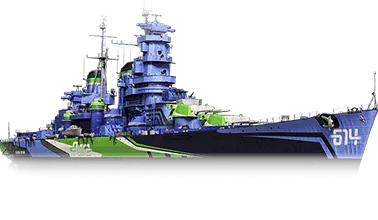
Riga CLR
WoWS World of Warships U.S.S.R. Cruiser · Tier IX
- Main Battery
- 220 mm/60 on an SM-7 mount
- 3 turrets × 3 barrels
- Range 18 km
- Secondaries
- 130 mm/60 on a BL-101 mount
- Range 6.95 km
Specifications
Survivability
Main Battery
 HE Shell
 AP Shell
Secondary Battery

AA Defense
Maneuverability
Concealment
Consumables

Extinguishes fires, removes instances of flooding, and repairs damaged modules. Prevents enemy acoustic torpedoes from homing.

Partially restores the ship's HP by repairing any light damage.

Increases the range of assured acquisition of enemy ships and torpedoes, including those within smoke screens.

Increases the intensity of AA fire.
Significantly increases the range of assured acquisition of ships and submarines on the surface, including those within smoke screens.

Follow the ship and automatically attack enemy aircraft. Can attack Airstrike squadrons multiple times before returning to the ship. Cannot spot enemy ships.
Extends main battery firing range.

Carries out aerial bombardment of the marked area with depth charges. Depth charges can hit enemy submarines. They also have chances of causing fire, flooding, and incapacitating modules. Increased chances of incapacitating sonar. Effective against enemy mines. Cannot spot enemy ships.
Ballistics
Armor Model
Overview
After acquiring the heavy cruiser Lützow from Germany, Soviet specialists studied the ship's design documentation. Soon, the idea emerged to create improved ships based on the German design. On the orders of the People's Commissar of the Navy, Admiral N.G. Kuznetsov, the Main Naval Staff prepared a preliminary operational-tactical specification for the design of such a ship, which received the project index 82. The design bureau of the Navy's Scientific and Technical Committee developed three variants of the preliminary design. The operational-tactical specification was adjusted based on the experience of naval combat operations, and in September 1943, a second edition was issued, in which the main caliber was increased to 220 mm and universal 130 mm guns were added. Based on this specification, TsKB-17 developed eight variants of sketches by the end of May. In this form, the ship was not approved for construction, but the further development of the project led to the emergence of the "Stalingrad"-class heavy cruisers.
Modules



Upgrades
Slot 1
Main & Intermediate Battery Modification 1
Weapon Survivability System

Damage Control Party Modification 1
Spotting Aircraft Modification 1
Slot 2
Engine Room Protection

Damage Control System Modification 1

Surveillance Radar Modification 1

Hydroacoustic Search Modification 1

Defensive AA Fire Modification 1
Slot 3
Aiming Systems Modification 1
Secondary Battery Modification 1
Main & Intermediate Battery Modification 2
Slot 4

Bomb Stabilizer
Steering Gears Modification 1
Propulsion Modification 1

Damage Control System Modification 2
Slot 5
Ship Consumables Modification 1
Steering Gears Modification 2
Concealment System Modification 1
Torpedo & Mine Lookout System
Slot 6
Auxiliary Armaments Modification 2
Gun Fire Control System Modification 2