
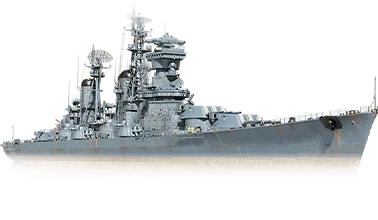
 U.S.S.R.EliteLesta
Novosibirsk
WoWS World of Warships U.S.S.R. Cruiser · Tier ★
- Main Battery
- 254 mm/55 B-48 on a MK-13 mount
- 3 turrets × 3 barrels
- Range 19 km
- Secondaries
- 152 mm/57 on a BL-115 mount
- Range 7.3 km
Specifications
Survivability
Main Battery
 HE Shell
 AP Shell
Secondary Battery

AA Defense
Maneuverability
Concealment
Consumables

Extinguishes fires, removes instances of flooding, and repairs damaged modules. Prevents enemy acoustic torpedoes from homing.

Partially restores the ship's HP by repairing any light damage.

Increases the range of assured acquisition of enemy ships and torpedoes, including those within smoke screens.

Increases the intensity of AA fire.

Significantly increases the range of assured acquisition of ships and submarines on the surface, including those within smoke screens.

Carries out aerial bombardment of the marked area with depth charges. Depth charges can hit enemy submarines. They also have chances of causing fire, flooding, and incapacitating modules. Increased chances of incapacitating sonar. Effective against enemy mines. Cannot spot enemy ships.
Ballistics
Armor Model
Overview
In the mid-1930s, the USSR began designing large artillery ships for the future 'large fleet.' In February 1936, the Shipbuilding Department of the Navy Directorate formed a tactical-technical assignment for the heavy cruiser project. Engineers from TsKBS-1 prepared four variants of the preliminary design with armament ranging from 254 to 305 mm, but in the course of further development, these drafts led to the appearance of battleship projects 25 and 64. The idea of building a heavy cruiser was revisited in the late 1930s—the new project received the index 69. Had construction begun in the second half of the 1930s, the ship would have been completed only after the end of the Great Patriotic War. Such a cruiser would have performed tasks such as convoy escort, support for landing operations, and would have been used as the flagship of an expeditionary squadron of the Mediterranean Fleet.
Modules



Upgrades
Slot 1
Main & Intermediate Battery Modification 1
Weapon Survivability System

Damage Control Party Modification 1
Slot 2

Engine Room Protection

Damage Control System Modification 1

Surveillance Radar Modification 1

Hydroacoustic Search Modification 1

Defensive AA Fire Modification 1
Slot 3
Aiming Systems Modification 1
Secondary Battery Modification 1
Main & Intermediate Battery Modification 2
Slot 4

Bomb Stabilizer
Steering Gears Modification 1

Propulsion Modification 1

Damage Control System Modification 2
Slot 5
Ship Consumables Modification 1
Steering Gears Modification 2
Concealment System Modification 1
Torpedo & Mine Lookout System
Slot 6
Auxiliary Armaments Modification 2
Gun Fire Control System Modification 2
Main & Intermediate Battery Modification 3
Slot 7

Enhanced AA Defense System
Gun Fire Control System Modification 3

Sustainability Support System
Close-Quarters Combat Defense System