 U.S.S.R.PremiumLesta
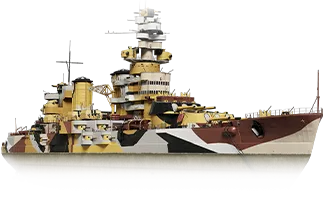
Frunze
WoWS World of Warships U.S.S.R. Battleship · Tier VIII
- Main Battery
- 305 mm/52 Model 1907 in MK-3-12 mount
- 3 turrets × 3 barrels
- Range 17.8 km
- Secondaries
- 130 mm/55 Model 1913 on an Obukhov Plant mounting
- Secondaries
- 100 mm/56 B-54 on an MZ-16 mount
- Range 7.5 km
- Torpedoes
- 533 mm Triple 39-U
- 2 launchers × 3 tubes
- Range 8 km
Specifications
Survivability
Main Battery
 HE Shell
 AP Shell
Torpedoes
 53-31
53-31Secondary Battery

AA Defense
Maneuverability
Concealment
Consumables

Extinguishes fires, removes instances of flooding, and repairs damaged modules. Prevents enemy acoustic torpedoes from homing.

Follow the ship and automatically attack enemy aircraft. Can attack Airstrike squadrons multiple times before returning to the ship. Cannot spot enemy ships.

Extends main battery firing range.

Partially restores the ship's HP by repairing any light damage.

Carries out aerial bombardment of the marked area with depth charges. Depth charges can hit enemy submarines. They also have chances of causing fire, flooding, and incapacitating modules. Increased chances of incapacitating sonar. Effective against enemy mines. Cannot spot enemy ships.
Ballistics
Armor Model
Overview
The battleship 'Poltava' was severely damaged by fire in November 1919: the wiring was completely destroyed, and the boilers and power stations were damaged. With extremely limited funding, the decision was made to disarm and mothball the ship. In 1926, the battleship was renamed 'Frunze.' That same year, the ship's restoration was included in the Red Army's naval construction program. Restoration projects were developed in 1928 and 1930. In 1931, a proposal was made to convert 'Frunze' into a three-turret battlecruiser using the original turrets. The following year, the Shipbuilding Directorate placed an order for the development of a preliminary design, and in 1933, the Baltic Shipyard Design Bureau prepared two variants, differing in smokestack configuration and anti-aircraft artillery layout. The battleship's modernization was included in the naval construction program for 1933–38. However, in the following year, the modernization was postponed and later canceled.
Modules



Upgrades
Slot 1
Torpedo Tubes Modification 1
Main & Intermediate Battery Modification 1
Weapon Survivability System

Damage Control Party Modification 1

Spotting Aircraft Modification 1
Slot 2

Engine Room Protection

Damage Control System Modification 1
Slot 3

Torpedo Tubes Modification 2
Aiming Systems Modification 1

Secondary Battery Modification 1
Main & Intermediate Battery Modification 2
Slot 4

Bomb Stabilizer
Steering Gears Modification 1

Propulsion Modification 1

Damage Control System Modification 2
Slot 5
Ship Consumables Modification 1
Concealment System Modification 1