 JapanEliteLesta
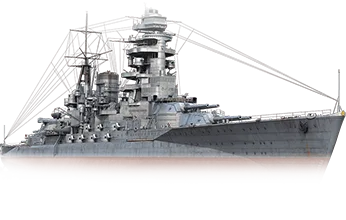
Nagato
WoWS World of Warships Japan Battleship · Tier VII
- Main Battery
- 410 mm/45 3rd Year Type in a twin turret
- 4 turrets × 2 barrels
- Range 20.5 km
- Secondaries
- 127 mm/40 Type 89 on a Model A1 mount
- Secondaries
- 140 mm/50 3rd Year Type on a casemate mount
- Range 5.6 km
Specifications
Survivability
Main Battery
 AP Shell
 HE Shell
Secondary Battery

AA Defense
Maneuverability
Concealment
Consumables

Extinguishes fires, removes instances of flooding, and repairs damaged modules. Prevents enemy acoustic torpedoes from homing.

Partially restores the ship's HP by repairing any light damage.
Extends main battery firing range.
Follow the ship and automatically attack enemy aircraft. Can attack Airstrike squadrons multiple times before returning to the ship. Cannot spot enemy ships.

Carries out aerial bombardment of the marked area with depth charges. Depth charges can hit enemy submarines. They also have chances of causing fire, flooding, and incapacitating modules. Increased chances of incapacitating sonar. Effective against enemy mines. Cannot spot enemy ships.
Ballistics
Armor Model
Overview
The Nagato-class battleships were the first Japanese battleships not only built but also entirely designed in Japan. The 410 mm caliber guns were developed in response to British 381 mm armament. Their speed was increased compared to their predecessors, a fact which Japan concealed. Nagato was built in Kure. Between 1933 and 1936, the battleship underwent a major modernization that included enhanced armor. It participated in World War II, serving as the flagship of Admiral Isoroku Yamamoto during the attack on Pearl Harbor. In 1942, it took part in the Battle of Midway and the Solomon Islands campaign. During the Battle of Leyte Gulf, the battleship sustained damage and, after the war, was surrendered to the United States as a war reparation. In 1946, the battleship became a target for nuclear weapon tests at Bikini Atoll as part of Operation Crossroads. Nagato, which had been damaged late in World War II, successfully withstood two nuclear explosions and sank on July 30, 1946, as it was impossible to conduct damage control on the radioactive ship.
Modules
Upgrades
Slot 1
Main & Intermediate Battery Modification 1
Weapon Survivability System

Damage Control Party Modification 1
Spotting Aircraft Modification 1
Slot 2
Engine Room Protection
Damage Control System Modification 1
Slot 3
Aiming Systems Modification 1
Secondary Battery Modification 1
Main & Intermediate Battery Modification 2
Slot 4

Bomb Stabilizer
Steering Gears Modification 1
Propulsion Modification 1