 GermanyEliteLesta
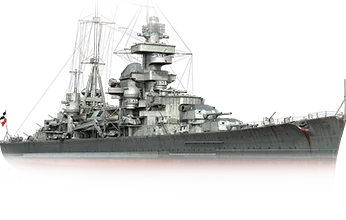
Hipper
WoWS World of Warships Germany Cruiser · Tier VIII
- Main Battery
- 203 mm/60 SK C/34 on an LC/34 mount
- 4 turrets × 2 barrels
- Range 16.1 km
- Secondaries
- 105 mm/65 SK C/33 on a Dop. L. C/31 mount
- Range 7.6 km
- Torpedoes
- 533 mm Drilling
- 4 launchers × 3 tubes
- Range 6 km
Specifications
Survivability
Main Battery
 AP Shell
 HE Shell
Torpedoes
 G7a T1
Secondary Battery

AA Defense
Maneuverability
Concealment
Consumables

Extinguishes fires, removes instances of flooding, and repairs damaged modules. Prevents enemy acoustic torpedoes from homing.

Partially restores the ship's HP by repairing any light damage.

Increases the range of assured acquisition of enemy ships and torpedoes, including those within smoke screens.
Increases the intensity of AA fire.

Follow the ship and automatically attack enemy aircraft. Can attack Airstrike squadrons multiple times before returning to the ship. Cannot spot enemy ships.

Carries out aerial bombardment of the marked area with depth charges. Depth charges can hit enemy submarines. They also have chances of causing fire, flooding, and incapacitating modules. Increased chances of incapacitating sonar. Effective against enemy mines. Cannot spot enemy ships.
Ballistics
Armor Model
Overview
In early 1934, technical specifications were developed for a heavy cruiser project, whose intended opponents were to be French and British ships of this class. The first draft designs appeared in the summer. Engineers abandoned the diesel power plant in favor of turbines and boilers with high steam parameters. Admiral Hipper, the lead cruiser of the type, was built in Kiel. At the start of World War II, an 'Atlantic' bow was installed on the cruiser. During the invasion of Denmark and Norway, Hipper was the flagship of the 2nd group of ships conducting the landing at Trondheim. During the operation, Admiral Hipper was rammed by the British destroyer Glowworm. In 1940–42, the ship conducted raids into the Atlantic and attacks on convoys. In December 1942, Hipper was damaged during an attack on convoy JW51B in the Barents Sea. The cruiser was placed in reserve, where it remained until the end of the war.
Modules


Upgrades
Slot 1
Torpedo Tubes Modification 1
Main & Intermediate Battery Modification 1
Weapon Survivability System

Damage Control Party Modification 1
Slot 2
Engine Room Protection
Damage Control System Modification 1

Hydroacoustic Search Modification 1

Defensive AA Fire Modification 1
Slot 3
Torpedo Tubes Modification 2
Aiming Systems Modification 1
Secondary Battery Modification 1
Main & Intermediate Battery Modification 2
Slot 4

Bomb Stabilizer
Steering Gears Modification 1
Propulsion Modification 1
Damage Control System Modification 2
Slot 5
Ship Consumables Modification 1
Steering Gears Modification 2
Concealment System Modification 1