
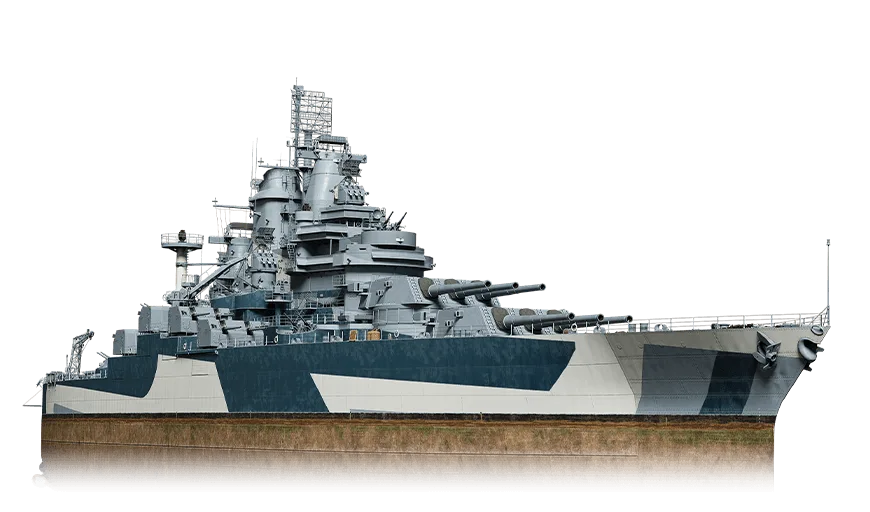
 Pan-AmericaSpecialRareGlobal
Sete de Setembro
WoWS World of Warships Pan-America Battleship · Tier X
- Main Battery
- 406 mm/56 Mk.4 in a turret
- 4 turrets × 3 barrels
- Range 25.3 km
- Secondaries
- 127 mm HE Mk41
- Range 8.3 km
Specifications
Sete de Setembro Win Rate & Combat Stats
Sample of 495.2K players · as of 2026-10-15Averages from our own crawled player sample, not official server-wide data. The sample skews toward active clan players, so its overall win rate runs about 1 point above the true server average. Battle counts are career totals and include games played before this ship’s past balance changes.
Survivability
Main Battery
 AP Shell
 HE Shell
Secondary Battery

AA Defense
Maneuverability
Concealment
Combat Instructions
- Hit the citadel of an enemy ship+50
- Penetrate enemy ship armor with main battery shells+5
- Over-penetrate enemy ship armor with main battery shells+5
Consumables

Extinguishes fires, removes instances of flooding, and repairs damaged modules. Prevents enemy acoustic torpedoes from homing.

Partially restores the ship's HP by repairing any light damage.

Temporarily boosts the performance of secondary, torpedo, and airstrike armaments.

Follow the ship and automatically attack enemy aircraft. Can attack Airstrike squadrons multiple times before returning to the ship. Cannot spot enemy ships.

Extends main battery firing range.

Carries out aerial bombardment of the marked area with depth charges. Depth charges can hit enemy submarines. They also have chances of causing fire, flooding, and incapacitating modules. Increased chances of incapacitating sonar. Effective against enemy mines. Cannot spot enemy ships.

Sete de Setembro Change History
- Buffpercent of non-citadel damage that can be restored50 → 60 %
New activation effect added to Combat Instructions
- consumable reload time-20 %
- time before combat instructions start losing progress50 → 90 s
- percent of damage received to hull parts that can be restored60 → 75 %
- Buffmain battery maximum range11.1 → 12.9 km
Torpedo parameters changed
- Nerfmaximum range6.8 → 6 km
- Speed increased: 53 to 75kt
- Nerfdetectability range0.6 → 1.6 km
Engine Boost consumable parameters changed
- Buffreload time120 → 60 s
- Nerfaction time120 → 45 s
- Buffbonus to maximum speed8 → 20 %
- Buffsigma value1.9 → 2
Ballistics
Armor Model
Overview
One of the planned South Dakota–class battleships that the United States intended to build in the 1920s. During the 1930s and 1940s, such ships would have undergone significant refits to their armament and appearance. This could have included the possible installation of the U.S. Navy's experimental 406 mm/56 Mk 4 guns, developed and tested during the same period. After the end of hostilities, the U.S. Navy would no longer have required such a ship and could have sold her to Brazil along with several smaller ships.
Modules

406 mm/56 Mk.4 in a turret
Main Battery

Sete de Setembro
Hull

Propulsion: 72,000 hp
Engine

Mk10 mod. 1
Fire Control
Upgrades
Slot 1

Auxiliary Armaments Modification 1

Main Armaments Modification 1

Damage Control Party Modification 1

Spotting Aircraft Modification 1
Slot 2

Engine Room Protection

Damage Control System Modification 1
Slot 3

Aiming Systems Modification 1

AA Guns Modification 1

Secondary Battery Modification 1

Main Battery Modification 2
Slot 4

Airstrike Modification 1

Steering Gears Modification 1

Propulsion Modification 1

Damage Control System Modification 2
Slot 5

Ship Consumables Modification 1

Concealment System Modification 1

Torpedo Lookout System
Slot 6

Auxiliary Armaments Modification 2

Gun Fire Control System Modification 2
