 U.S.S.R.EliteCommonGlobal
Podvoisky
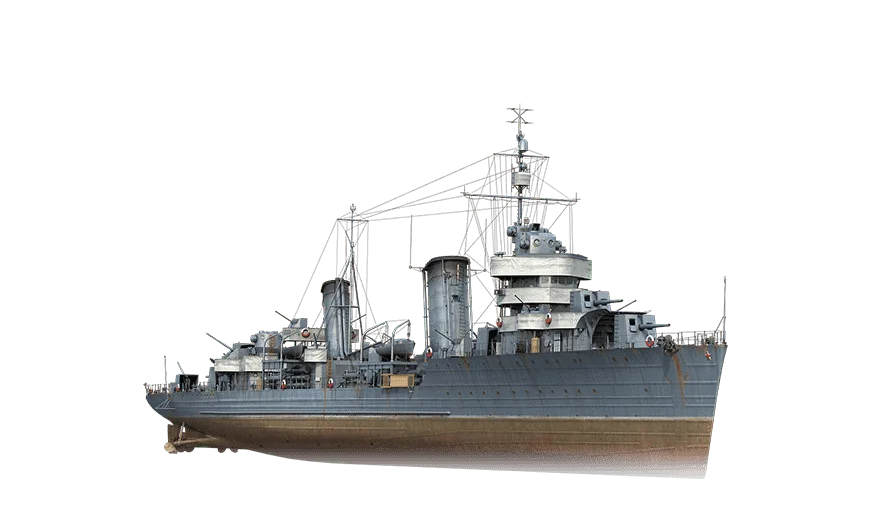
WoWS World of Warships U.S.S.R. Destroyer · Tier V
- Main Battery
- 130 mm/55 Model 1913 on an Obukhov Plant mounting
- 5 turrets × 1 barrels
- Range 9.5 km
- Torpedoes
- 533 mm Triple 39-U
- 2 launchers × 3 tubes
- Range 6 km
Specifications
Podvoisky Win Rate & Combat Stats
Sample of 495.2K players · as of 2026-10-15Averages from our own crawled player sample, not official server-wide data. The sample skews toward active clan players, so its overall win rate runs about 1 point above the true server average. Battle counts are career totals and include games played before this ship’s past balance changes.
Survivability
Main Battery
 AP Shell
 HE Shell
Torpedoes
 53-36 mod. 3
AA Defense
Maneuverability
Concealment
Depth Charges
Consumables

Extinguishes fires, removes instances of flooding, and repairs damaged modules. Prevents enemy acoustic torpedoes from homing.

Generates a smoke screen that reduces the risk of being detected by the enemy.

Partially restores the ship's HP by repairing any light damage.

Increases ship's maximum speed.

Podvoisky Change History
Stock Torpedo parameters changed
- Buffrange4 → 6 km
- Nerfmaximum damage14,400 → 11,233
- Buffreload time70 → 67 s
- Speed reduced: 64 to 55 knots
- Nerfdetection firing range1.3 → 1.1 km
Researchable torpedo parameters changed
- Buffrange4 → 6 km
- Nerfdamage14,400 → 11,233
- Speed reduced: 65 to 59 knots
- Nerfdetection firing range1.3 → 1.2 km
- Buffmain battery turret traverse time18.6 → 12.9 s
- Repair Party added in the same slot as Smoke generator. Parameters are similar to those found on Ognevoi
Smoke Generator consumable parameters changed. The consumable now has the following characteristics
- action time20 s
- smoke dispersion time85 s
- reload time120 s
- number of charges3
- Buffthe number of bombs in charge4 → 6
Detectability range by sea reduced: 7.5 to 7.1 km.
- All other types of detectability reduced accordingly
Ballistics
Armor Model
Overview
In 1928, a design of a 40-knot destroyer for the Black Sea Fleet was developed. General arrangement drawings were approved in 1929. The construction of the planned ships never started due to cuts in the navy's shipbuilding budget. Later, Leningrad-class leaders were laid down and built to an improved design (Project 1).
Modules

130 mm/55 Model 1913 on an Obukhov Plant mounting
Main Battery

53-36 mod. 1
Torpedoes
53-38
Torpedoes

Podvoisky (A)
Hull
Podvoisky (B)
Hull

Propulsion: 66,000 hp
Engine

GFCS V mod. 1
Fire Control
GFCS V mod. 2
Fire Control
Upgrades
Slot 1

Auxiliary Armaments Modification 1

Main Armaments Modification 1

Damage Control Party Modification 1
Slot 2

Engine Room Protection

Damage Control System Modification 1

Engine Boost Modification 1
Slot 3

Torpedo Tubes Modification 1

Aiming Systems Modification 1

AA Guns Modification 1

Main Battery Modification 2
