
 U.K.SpecialUncommonGlobal
Malta
WoWS World of Warships U.K. Aircraft Carrier · Tier X
- Secondaries
- 113 mm HE Mk XVI
- Range 5 km
Specifications
Malta Win Rate & Combat Stats
Sample of 495.2K players · as of 2026-10-15Averages from our own crawled player sample, not official server-wide data. The sample skews toward active clan players, so its overall win rate runs about 1 point above the true server average. Battle counts are career totals and include games played before this ship’s past balance changes.
Survivability
Secondary Battery
AA Defense
Maneuverability
Concealment
Aircraft
 Dive Bomber
 Fighter
 Torpedo Bomber
Consumables

Extinguishes fires, removes instances of flooding, and repairs damaged modules. Prevents enemy submarine-launched torpedoes from homing.

Follow the ship and automatically attack enemy aircraft. Can attack Airstrike squadrons multiple times before returning to the ship. Invulnerable against hostile fighters, do not attack them, and cannot spot enemy ships.

Carries out aerial bombardment of the marked area with depth charges. Depth charges can hit enemy submarines. They also have chances of causing fire, flooding, and incapacitating modules. Increased chances of incapacitating sonar. Effective against enemy mines. Cannot spot enemy ships.
Malta Change History
Torpedo bomber squadron parameters changed
- Buffaircraft preparation time64 → 61 s
Dive bomber squadron parameters changed
- Buffaircraft preparation time51 → 49 s
Attack aircraft squadron parameters changed
- Buffaircraft preparation time64 → 61 s
- torpedo bomber torpedo damage5,933 → 6,533
- number of bombs in payload on dive bombers4 → 3
Changed the parameters of attack aircraft (HE).
- Decreased rocket dispersion ellipse by approximately 18%.
- Reduced rocket launch interval: 0.08 to 0.06 s.
Armor Model
Overview
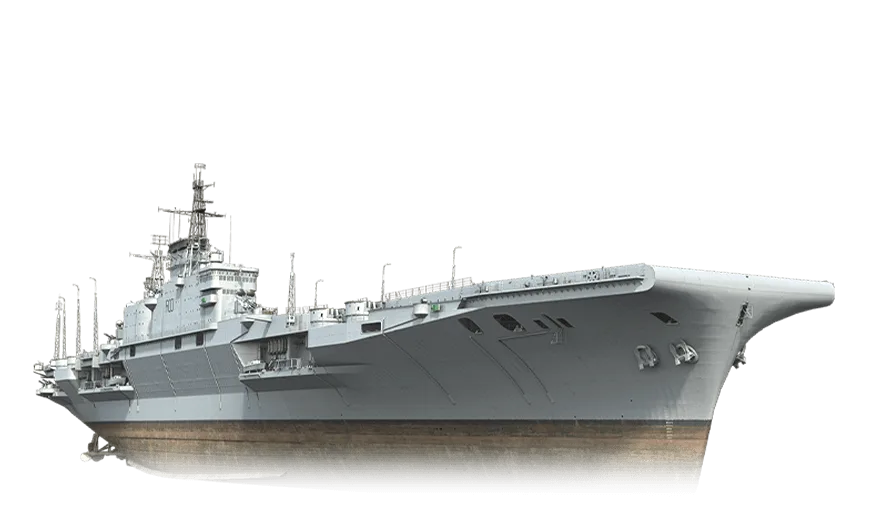
1942 sparked an idea to build an aircraft carrier whose size would be limited only by the dock dimensions. In late 1942, work on Project X1 commenced—a ship with a displacement of 56,800 tons. The main disputes arose around the hangar, as previous ships were built with an entirely closed hangar. However, the U.S. aircraft carriers' operating experience showed that it's necessary to warm up aircraft engines in the hangar to carry out a massive launch of the air group. The choice fell on a project with an open hangar and two aircraft lifts on the port side. All works were stopped with the end of World War II.
Modules

Malta
Hull

Propulsion: 200,000 hp
Engine

Blackburn Firebrand
Fighter

Blackburn Firebrand
Torpedo Bomber

Blackburn Firebrand
Dive Bomber
Upgrades
Slot 1

Auxiliary Armaments Modification 1

Air Groups Modification 1

Damage Control Party Modification 1
Slot 2

Aircraft Engines Modification 1

Damage Control System Modification 1
Slot 3

Aerial Torpedoes Modification 1

Attack Aircraft Modification 1

Torpedo Bombers Modification 1

Secondary Battery Modification 1
Slot 4

Airstrike Modification 1

Bombers Modification 1

Torpedo Bombers Modification 2

Attack Aircraft Modification 2

Damage Control System Modification 2
Slot 5

Squadron Consumables Modification 1

Concealment System Modification 1

Flight Control Modification 1
Slot 6

Auxiliary Armaments Modification 2

Air Groups Modification 2
